Section 2 - Type-theoretic Framework
- Singleton kinds
- note that the syntax constructor (applied to monotypes) is generalized to a certain class of well-formed kinds (with proper restriction on positivity and dependent sum kinds)
- value restriction via
valuablefor recursive functions - contraction condition for equi-recursive type constuctors
2.2 The Structure Calculus
- module (or structures
s)M = [c, e]for constructors and expressions - signatures
S = [alpha:k, sigma]for kinds and types (ehas typesigma[alpha/k])
Related work: higher order modules can be reduced to flattened structure calculus
Section 3 - Opaque Recursive Modules
- We get an opaque encoding for free in the core language
- It is not enough for the purpose of programming mutually recursive modules
- The
declexprmutually recursive examples
- The
Section 4 - Transparent Recursive Modules
What we need is a means of propagating the type equations, such that exp is known to be Decl.exp
Solution: Recursive Dependent Signature - making what is necessary transparent
e.g. make t = ... | List.t part of the contract
Section 4.1 Functors and Separate Compilation
- in order to achieve separate compilation, we can write functors and then gluing the functors by instantiating them in a recursive structure binding
- However, by checking closely, for sake of in-opacity, we are forced to provide recursively dependent signature for
ExprandDecl, specifying the other module- Code may be separate, type may not
- See Section 5.1 for relaxation
Section 4.2 Formalization
It can be shown, for recursive dependent signature rho s. S
- we have
- intro/elim rules for
M : rho s. Sauto unfold/folding - well-formed rules enforcing static components in
Sto be fully transparent
- intro/elim rules for
- we show
rho s. Scan be encoded by a recursive type constructor- the rules above follow from the definition, need not be primitive
Section 4.3 Opacity revisited
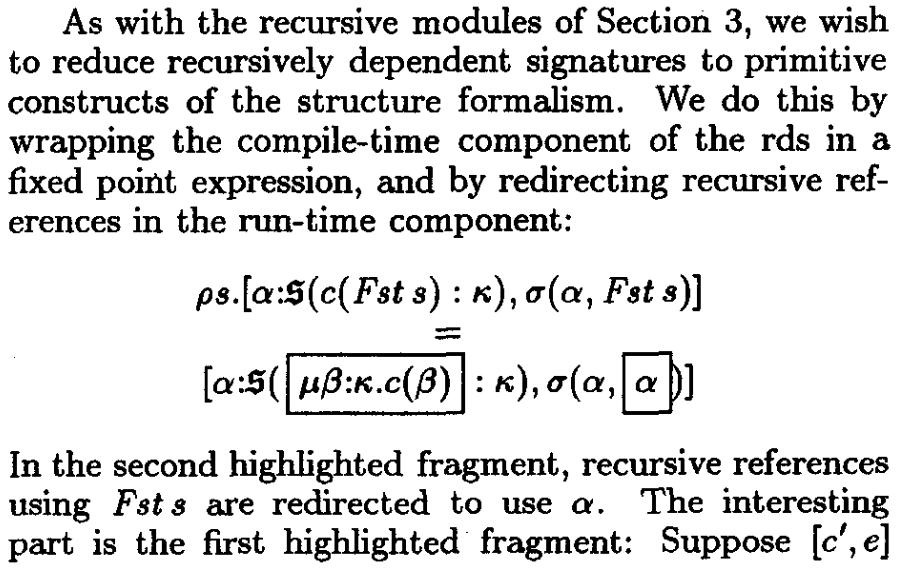
From the rules, we can see that the only part that is recursive is
- static-on-static (types on types)
dynamic-on-dynamic (terms on types)(by redirecting toFst s)
I guess the authors’s point here is that, though it is possible to avoid static-on-static with other means, this will be beyond the paper’s concern (on ML modules, statically typed programming …)
Not quite true, see Opacity Revisited in Recursive Modules
Corrected view:
- see the two examples, where in the opaque version we use
Decl.make_valbut with transparent signature we can directly useDecl.VALconstructorThere goes: One can always program opaquely (i.e., without any type sharing information) if one is willing to incur mediating function calls between types that are actually equal. Tools for supplying type equality information, such as sharing [15], translucent sums [9,13], and recursively dependent signatures, serve only to improve performance.
Section 5 - External Language
5.1 Elaboration
- goal: lift the contractiveness / transparent requirement to the surface language
- idea: hoisting to make structures transparent
- not a complete solution See Elaboration of Recursively Dependent Signatures
5.2 Type Checking
structure rec A : ASIG(A) =
  struct ... body ... end
- Intended checking:
body(actual implementation) has typerho s. ASIG(s)under assumption thatAhas typerho s. ASIG(s) - Appealing checking:
rho s. ASIG(s)is well-formed- the structure definition has type
ASIG(A)under assumption thatAhas typeASIG(A)--- easier to check
- Authors show: the two are equivalent
5.3 Iso- vs. Equi- constructors
Conjecture: equi are not essentially necessary
- In #ToRead On the type Structure of Standard ML, their implementation of recursive datatype is an iso-recursive type
- If take a step back to recursive datatypes, with transparent technique, possible for iso-, using Shao’s equation
- Also discussed by Transparent and opaque interpretations of datatypes
- Authors show: bisimilarity rule + Shao’s equation + contractiveness ⇒ iso-recursive type for recursive module encoding
Extended Reading
- Mixin modules - Duggen and Sourelis
- Parameterized modules, recursive modules and mixin modules - Duggen and Sourelis